
Salah (also called namaz) is the formal Islamic prayer performed five times a day. To pray, you make wudu, face the Qibla, make the intention, and then move through standing, bowing, and prostrating while reciting set words. This guide walks you through every position and phrase, step by step, so a complete beginner can pray correctly.
What Is Salah (Prayer) in Islam?
Salah is the second pillar of Islam and the daily act of worship that connects a Muslim directly to Allah. It is performed at five fixed times each day and follows a set sequence of words and movements. Each complete unit of this sequence — standing, bowing, and prostrating — is called a rakat.
The exact prayer times change daily and by location, so most Muslims check a timetable. You can find accurate times for your city on our Islamic Prayer Times pages.
The 5 Daily Prayers and Their Rakats
Before learning the movements, it helps to know what you are aiming for. The table below shows the five obligatory (fard) prayers and how many rakats each one has.
| Prayer | Time of day | Fard rakats |
|---|---|---|
| Fajr | Dawn, before sunrise | 2 |
| Dhuhr | After midday | 4 |
| Asr | Late afternoon | 4 |
| Maghrib | Just after sunset | 3 |
| Isha | Night | 4 |
These counts are for the obligatory prayer only. Many Muslims also pray Sunnah and Nafl (voluntary) rakats before or after. For a full breakdown, see How Many Rakats in Each Prayer.
What You Need Before You Pray
Five conditions should be met before Salah is valid:
- Wudu (ablution): You must be in a state of ritual purity. Learn the steps in How to Perform Wudu.
- A clean body, clothes and place to pray on.
- Covering the awrah: men cover from navel to knee; women cover the whole body except the face and hands.
- Facing the Qibla (the direction of the Kaaba in Makkah). Not sure which way? Use our Qibla Direction Finder.
- The correct time has entered for that prayer.
How to Pray Step by Step (A 2-Rakat Prayer)
We will use the 2-rakat Fajr prayer as the model because it contains every position you need. Once you can pray two rakats, the longer prayers simply repeat the same units.
Step 1 — Make your intention (Niyyah)
Stand facing the Qibla and intend in your heart which prayer you are about to perform. The intention is made in the heart and does not need to be spoken aloud.
Step 2 — Opening Takbir (Takbiratul-Ihram)
Raise both hands to about ear or shoulder level and say:
Step 3 — Standing (Qiyam) and recitation

Place your right hand over your left on your chest and lower your gaze to the spot where you will prostrate. Then recite, in order:
- The opening supplication (Subhanaka Allahumma wa bihamdik…) — recommended.
- Seeking refuge: A’udhu billahi minash-shaytanir-rajeem.
- Surah Al-Fatihah (obligatory in every rakat — see the full text below).
- A short additional surah, such as Surah Al-Ikhlas (in the first two rakats).
Step 4 — Bowing (Ruku)
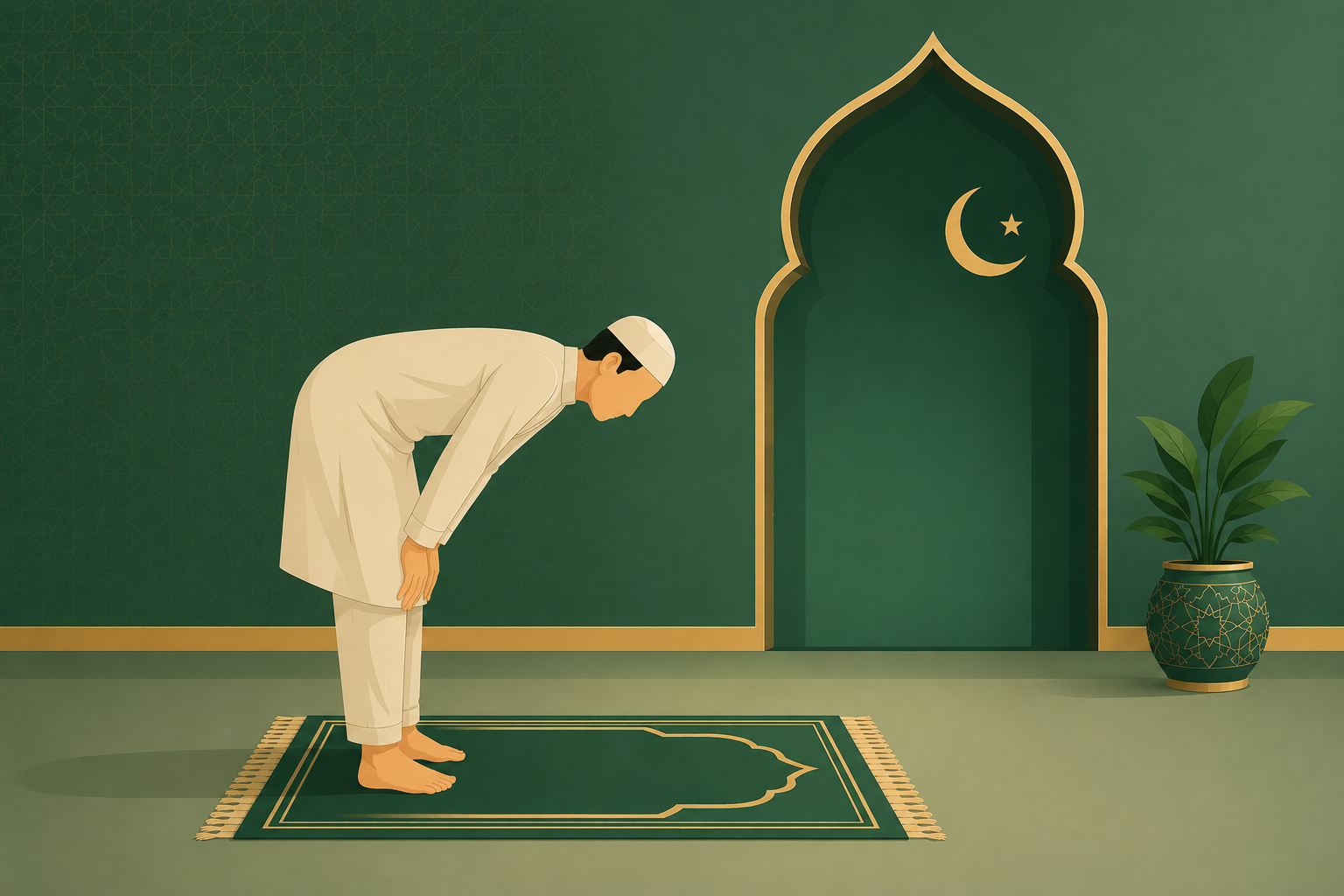
Say Allahu Akbar, then bow so your back is straight and your hands rest on your knees. While bowing, say three times:
Step 5 — Standing up (I’tidal)
Rise from bowing while saying Sami’Allahu liman hamidah (Allah hears the one who praises Him). Once standing upright, say Rabbana wa lakal-hamd (Our Lord, all praise is for You).
Step 6 — Prostration (Sujud)

Say Allahu Akbar and go down into prostration so that seven parts touch the ground: the forehead (with the nose), both palms, both knees, and the toes of both feet. Keep your elbows off the floor. Say three times:
Step 7 — Sitting between the two prostrations
Say Allahu Akbar, sit up calmly, and say Rabbighfir li (My Lord, forgive me). Then say Allahu Akbar and prostrate a second time, repeating the same words as in Step 6. This completes one rakat.
Step 8 — The second rakat and Tashahhud
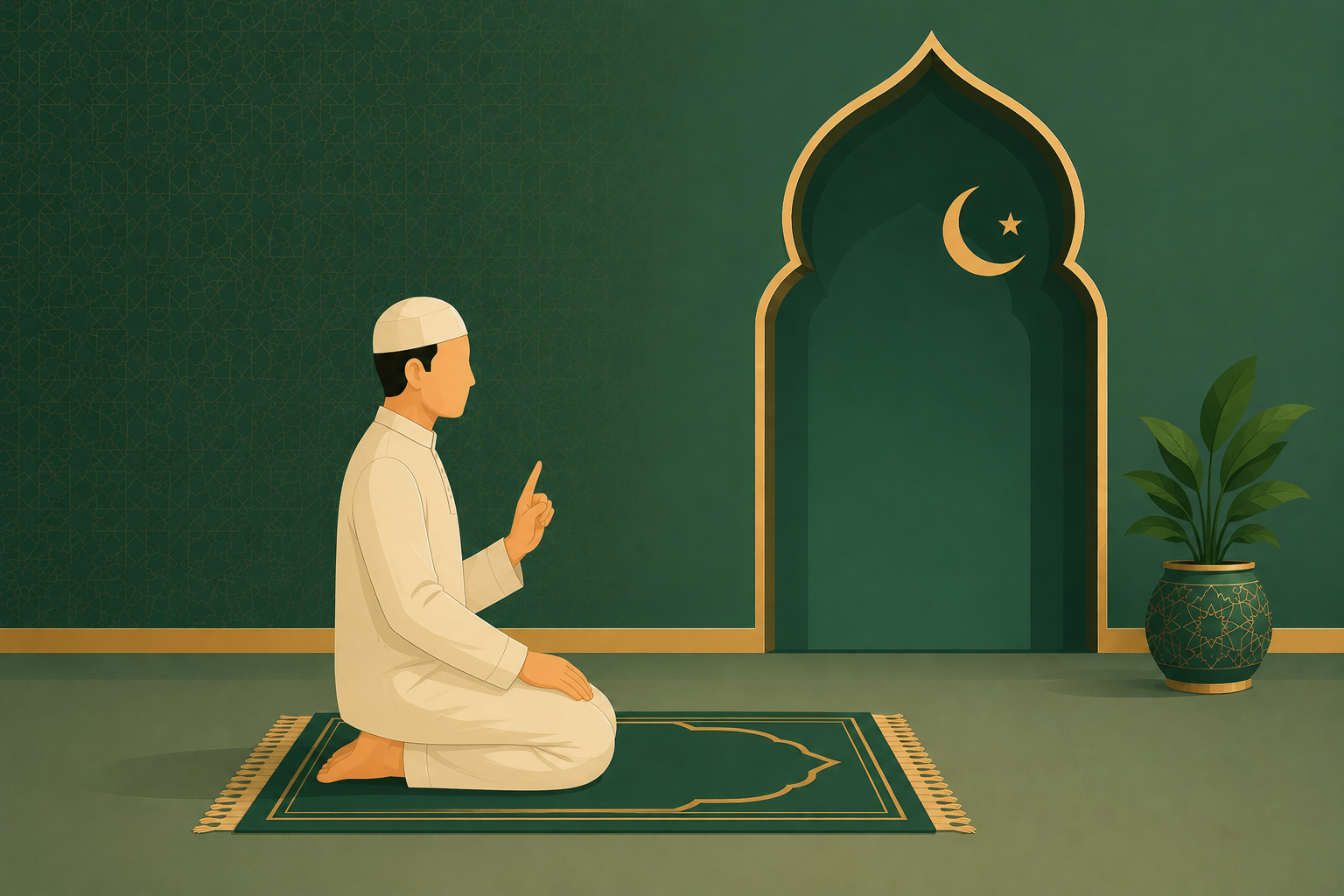
Stand up saying Allahu Akbar and repeat Steps 3 to 7 for the second rakat. After the second prostration of the final rakat, sit and recite the Tashahhud:
Follow it with the Durood (sending blessings on the Prophet, peace be upon him): Allahumma salli ‘ala Muhammadin wa ‘ala ali Muhammad…, then make a short personal dua.
Step 9 — Ending the prayer (Taslim)
Turn your head to the right and say As-salamu ‘alaykum wa rahmatullah, then turn to the left and repeat it. Your prayer is now complete.
How to Pray 3- and 4-Rakat Prayers
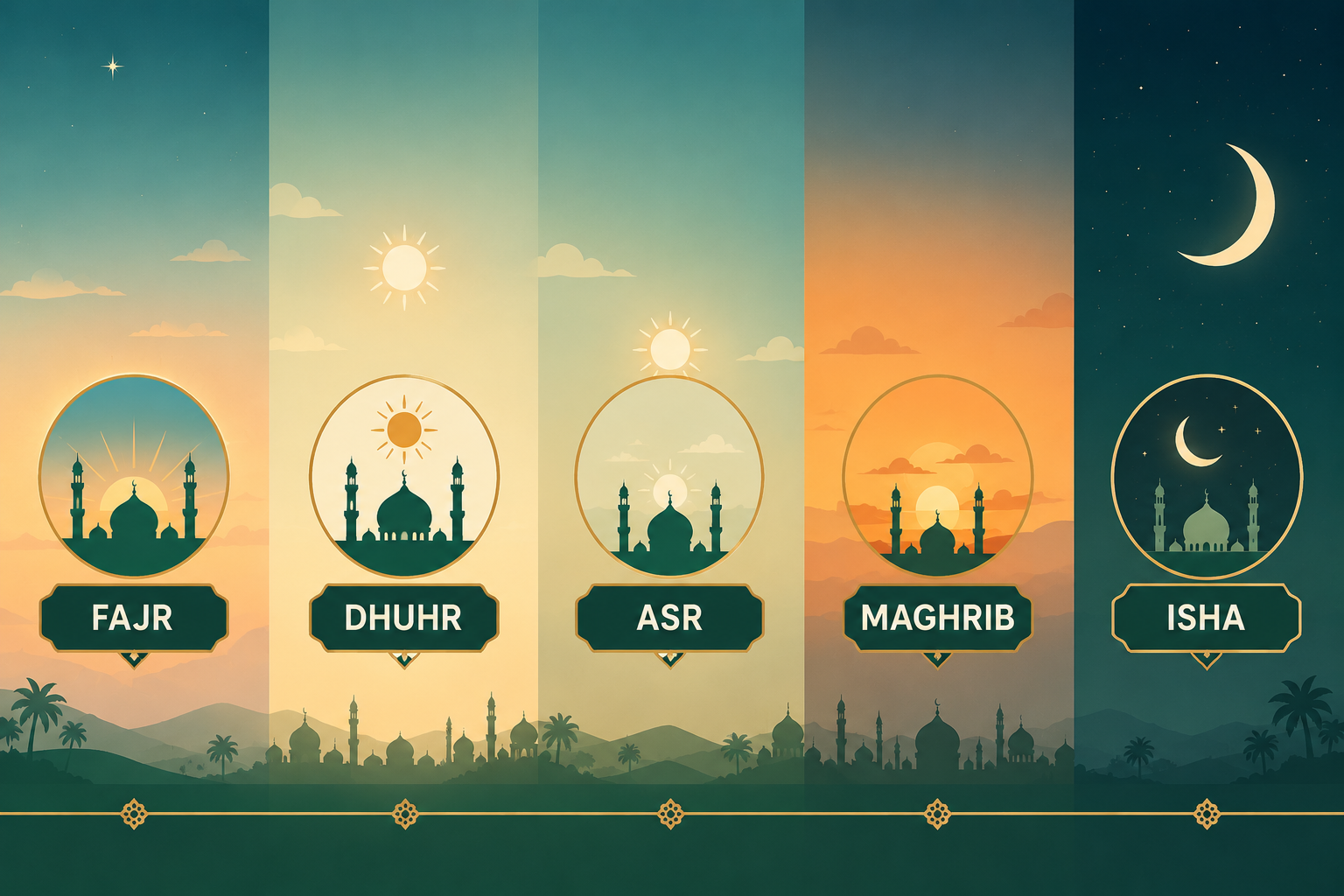
Longer prayers use the exact same positions. The only differences are when you sit and what you recite:
- Maghrib (3 rakats): Sit for a first Tashahhud after the 2nd rakat, stand for the 3rd rakat (reciting only Al-Fatihah, no extra surah), then sit for the final Tashahhud and end with Salam.
- Dhuhr, Asr, Isha (4 rakats): Sit for a first Tashahhud after the 2nd rakat, then pray the 3rd and 4th rakats reciting only Al-Fatihah, before the final Tashahhud and Salam.
In other words: an additional surah is read only in the first two rakats, and you sit briefly after the second rakat in any prayer longer than two.
What to Recite: Surah Al-Fatihah
Al-Fatihah is recited in every rakat of every prayer. Here is the transliteration and a plain meaning:
You can read the full Arabic and listen to the recitation on Quran.com.
Salah for Beginners: Tips to Get Started
- Learn one prayer first. Master the 2-rakat Fajr, then build up to the longer ones.
- Use transliteration to begin, but aim to learn the Arabic over time.
- Memorise Al-Fatihah and one short surah (Al-Ikhlas is the easiest start).
- Slow down. Each position should be calm and still before you move to the next.
- Be consistent. Praying on time daily matters more than praying perfectly at first.
New to Islam? See our dedicated guide on how to pray for new Muslims for a simplified walkthrough.
Common Mistakes to Avoid
- Rushing between positions without settling (lack of stillness, or tuma’ninah).
- Lifting the elbows incorrectly or resting them on the floor during prostration.
- Forgetting to recite Al-Fatihah in every rakat.
- Not facing the Qibla, or praying before the prayer time has started.
- Reciting an extra surah in the 3rd or 4th rakat (only Al-Fatihah is read there).
Frequently Asked Questions
How many times a day do Muslims pray?
Muslims pray five obligatory prayers each day: Fajr, Dhuhr, Asr, Maghrib and Isha, at fixed times from dawn to night.
How long does it take to pray Salah?
A 2-rakat prayer takes about 3 to 5 minutes, and a 4-rakat prayer about 5 to 8 minutes when performed calmly.
Can I pray Salah in English?
The prayer is recited in Arabic. Beginners may use transliteration to learn the words, but the goal is to recite the Arabic correctly. Your personal dua at the end may be made in any language.
What do I do if I make a mistake during prayer?
For minor errors, such as forgetting a position or adding one, you can perform two extra prostrations of forgetfulness (Sujud as-Sahw) before the final Salam.
Do men and women pray differently?
The core sequence is the same. There are minor differences in some postures according to different schools of thought; see our Salah guide for Muslim women for details.
What if I miss a prayer?
You should make it up (Qada) as soon as you are able. Missing a prayer due to genuine sleep or forgetfulness is excused, but it should still be performed when you remember.
Keep Learning
Now that you know the full sequence, continue with these guides: How to Perform Wudu, How Many Rakats in Each Prayer, and the Friday Prayer (Jummah). To pray on time, check today’s prayer times for your city.
A note on sources and schools of thought: This guide follows the broadly accepted Sunni method of prayer. Minor details (such as hand placement or saying certain phrases aloud) differ between the recognised schools of jurisprudence. For verified texts, see Quran.com and Sunnah.com, and consult a knowledgeable local imam for personalised guidance.